Cingal® A UniQue Formulation*
Cingal® A UniQue Formulation*
Cingal® (hyaluronic acid and triamcinolone hexacetonide) is indicated for the treatment of pain in osteoarthritis (OA) of the knee in patients who have failed to respond adequately to conservative non-pharmacologic therapy and to simple analgesics (e.g., acetaminophen). Cingal® includes an ancillary steroid to provide additional short-term pain relief.1
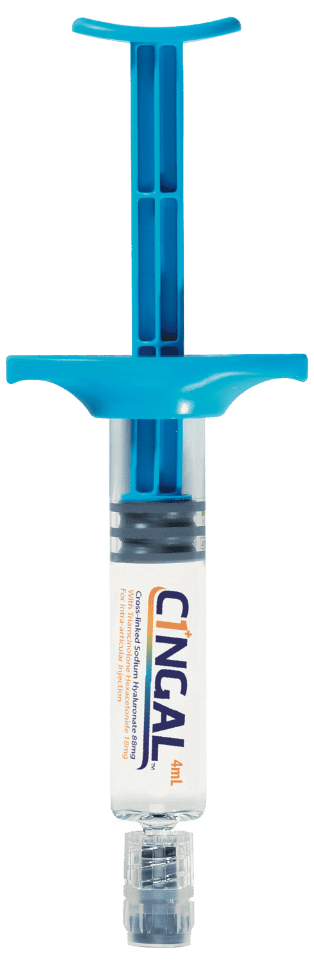
PROVIDING PAIN RELIEF TO HELP GET YOUR PATIENTS BACK TO THEIR ACTIVE LIFESTYLE
- Fast-acting pain relief from OA knee pain†,2
- Long-lasting, sustained duration of benefit‡,2
- Generally well-tolerated§,1
- Convenience of a single injection1
Cingal® combines Monovisc®, a high molecular weight HA, with triamcinolone hexacetonide (TH).1,3–6
Not all high molecular weight HAs are the same.
- HAs with a molecular weight ≤ 500,000 Da bind weakly to cell surface receptors¶,1,7,8
- HAs with a molecular weight ≥ 500,000 Da and ≤ 4,000,000 Da bind strongly to cell surface receptors¶,1,7,8
- HAs with a molecular weight ≥ 4,000,000 Da bind to cell surface receptors, but are restrained in the number of sites they can occupy¶,1,7,8
The HA in Monovisc® has a molecular weight of 1,000,000–2,900,000 Da.
MONOVISC® HA OFFERS: 8–13
- Effective OA pain relief for up to 6 months9–13
- Generally well-tolerated HA**,††,‡‡,§§§,9–13
Cingal® offers more HA per syringe than any other single injection (88 mg)***,9,14–17
Triamcinolone hexacetonide has been marketed for over 45 years for use in short-term symptomatic management of human joint OA.
FAST, LONG-LASTING, CONSISTENT2
WOMAC pain score percent reduction from baseline with Cingal®, Monovisc®, or saline in the ITT population***,†††,‡‡‡,1,2
Pain reduction (%)
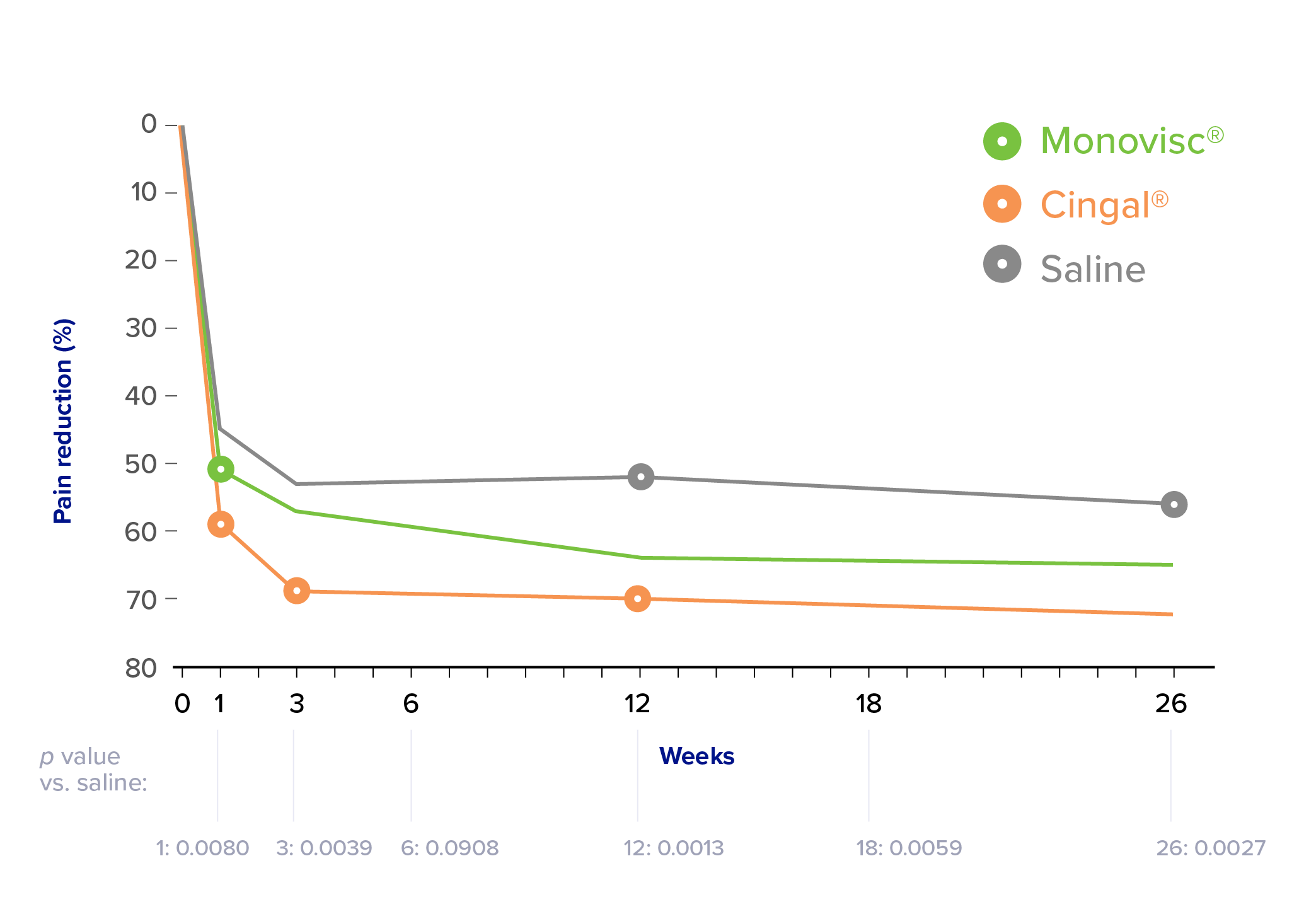
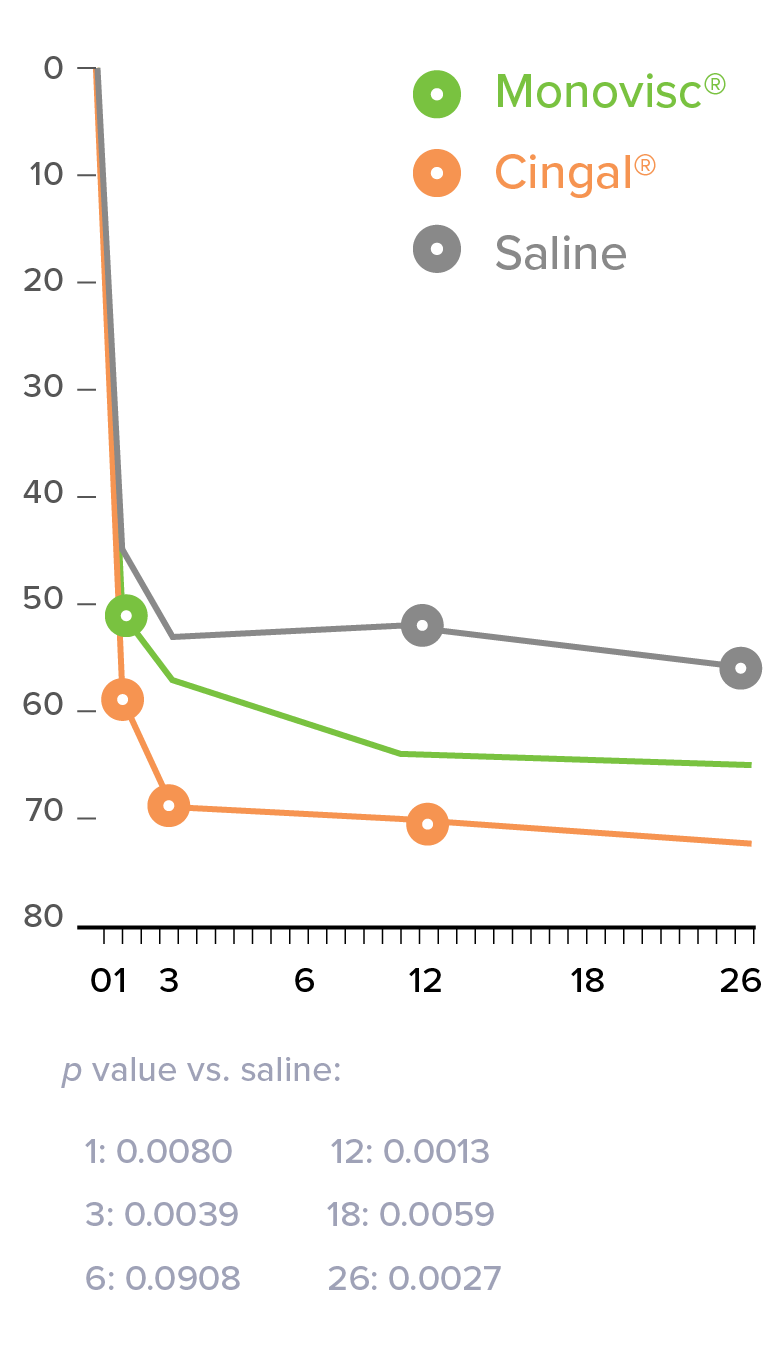
Weeks
FAST-ACTING2
Pain reduction Week 1§§§
WOMAC pain score vs. 45% for saline (p=0.0080)
LONG-LASTING2
Pain reduction Week 26
WOMAC pain score vs. 56% for saline (p=0.0027)
CONSISTENT¶¶¶,2
Response rate at Week 26 vs. 82% for saline (p<0.0100)
HOW TO ADMINISTER CINGAL®
Cingal® is injected through a sterile, disposable hypodermic needle of suitable gauge into the selected joint space. The sterile needle should be attached to the Cingal® syringe by a healthcare professional using healthcare-facility-approved aseptic technique. Recommended needle size for injections into the knee is 18–21 gauge. The final needle selection for any procedure is determined by the physician. The healthcare provider should ensure proper penetration into joint synovial space prior to injecting Cingal®.1
CINGAL® WAS GENERALLY WELL TOLERATED18
Adverse events (AEs) were distributed proportionally to study randomization, with no statistical differences related to study arm.
Most common AEs (> 5% of total AEs) regardless of relatedness to treatment:
- Headache (15.7%)
- Arthralgia (12.9%)
- Spinal pain (8.3%)
- Back pain (6.0%)
- Nasopharyngitis or common cold (5.1%)
The majority of AEs were transitory and rated mild (84.3%) in severity.
NO INJECTION-SITE INFECTIONS18
NO SERIOUS AEs RELATED TO CINGAL® REPORTED18
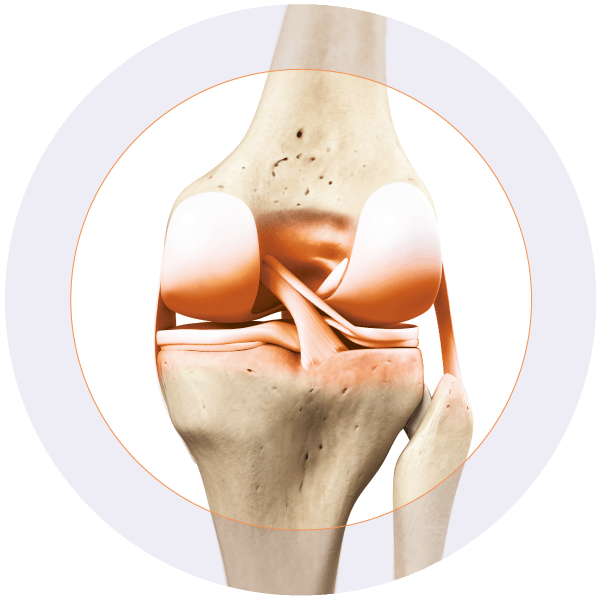
HIGH MOLECULAR WEIGHT HA3–5
CINGAL® WAS GENERALLY WELL TOLERATED18
Adverse events (AEs) were distributed proportionally to study randomization, with no statistical differences related to study arm.
Most common AEs (> 5% of total AEs) regardless of relatedness to treatment:
- Headache (15.7%)
- Arthralgia (12.9%)
- Spinal pain (8.3%)
- Back pain (6.0%)
- Nasopharyngitis or common cold (5.1%)
The majority of AEs were transitory and rated mild (84.3%) in severity.
NO INJECTION-SITE INFECTIONS18
NO SERIOUS AEs RELATED TO CINGAL® REPORTED18
HIGH MOLECULAR WEIGHT HA3–5
What your peers are saying.
A patient was so excited that he phoned in to let the clinic know how effective Cingal® is—specifically, he wanted to let his doctor know and thank him!
– Physician,**** Rebalance Clinic
A patient in BC phoned in to rave about Cingal®. The patient limped in originally, walked out, and was able to get back to his cherished activities, such as golf.
– Physician****
A patient phoned his sports clinic after his walking tour in Europe. He told the orthopedic clinic staff that there was no way he would have been able to manage the trip without Cingal®.
– Physician****
My knee flared up and became quite painful. After two weeks with no improvement, I decided to have my knee injected with Cingal®. Things improved rapidly, and I’m pleased to say I’m back to riding and training as hard as before.
– Cingal® patient and physician****
AE: adverse event; WOMAC: Western Ontario and McMaster Universities Osteoarthritis Index; ITT: intent-to-treat; OMERACT-OARSI: Outcome Measures in Rheumatoid Arthritis Clinical Trials-Osteoarthritis Research Society International
*A combination of steroid (triamcinolone hexacetonide) and hyaluronic acid for osteoarthritis, available in Canada.1 †Clinically meaningful reduction in knee pain elicited within 1 week of the injection. OMERACT-OARSI responder rate was significantly greater with Cingal® vs. saline (89% vs 75%, p=0.0161), and also significant in WOMAC pain score (p=0.0080).1 ‡Significant reduction of osteoarthritis-related pain and stiffness and improvement of function through 26 weeks.2 §The most common AEs (> 5% of total AEs) were headache (15.7%), arthralgia (12.9%), spinal pain (8.3%), back pain (6.0%), and nasopharyngitis, or common cold (5.1%). Most (> 99%) of the AEs were rated as “mild” or “moderate” in severity.1 ¶Based on preclinical in vitro data in human synovial fibroblasts and a narrative review, clinical significance has not been established. **In an open-label, multicentre study evaluating the safety and efficacy of Monovisc® for hip OA, none of the AEs were listed as related to study medication. No serious AEs were reported.11 ††In an open-label, multicentre study evaluating the safety and efficacy of Monovisc® for shoulder OA, one AE was listed as related to study medication (joint swelling). No serious AEs were reported.12 ‡‡In an open-label, multicentre study evaluating the safety and efficacy of Monovisc® for ankle OA, none of the AEs were listed as related to study medication. No serious AEs were reported.13 §§In a prospective, multicentre, double-blind, placebo-controlled, active-comparator study, subjects with confirmed knee OA were randomized to Cingal®, Monovisc®, or saline. Three AEs related to Monovisc® medication (arthralgia and rash) were reported. ¶¶Comparative clinical significance has not been established. ***Baseline values ± standard deviation (mm): Cingal® 59.0 ± 12.3; Monovisc® 61.0 ± 11.7; saline 58.8 ± 10.6. Pain reduction (WOMAC score ± standard deviation [mm]): Week 1: Cingal® (-34.6 ± 20.8); Monovisc® (-29.6 ± 21.4); saline (-26.6 ± 18.2), Week 3: Cingal® (-40.1 ± 20.1); Monovisc® (-34.9 ± 21.7); saline (-31.4 ± 18.8), Week 6: Cingal® (-40.5 ± 20.7); Monovisc® (-39.2 ± 20.4); saline (-35.5 ± 20.2), Week 12: Cingal® (-41.1 ± 20.5); Monovisc® (-39.0 ± 21.9); saline (-30.8 ± 23.7), Week 18: Cingal® (-40.5 ± 20.4); Monovisc® (-38.5 ± 23.8); saline (-31.4 ± 24.2), Week 26: Cingal® (-42.4 ± 18.7); Monovisc® (-39.5 ± 22.8); saline (-32.9 ± 23.6).2 †††Pain and symptom relief were not statistically different between Monovisc® and Cingal® treatments from Week 6 through Week 26. The Cingal® group had significantly lower difference in WOMAC pain scores from baseline than the saline group through 26 weeks in the ITT population with the exception of Week 6 (p=0.09).2 ‡‡‡The primary endpoint was the change from WOMAC baseline in knee pain through 12 weeks between Cingal® vs. saline. Secondary endpoints included the change from WOMAC baseline in knee pain at Weeks 1 and 3 between Cingal® and Monovisc®, and the change from WOMAC baseline in knee pain through 26 weeks between Cingal® and saline.2 §§§59% pain reduction corresponds to a difference from baseline of -34.6 mm and 45% to -26.6 mm at Week 1.18 ¶¶¶Cingal® showed significantly more responders versus saline at all time points except at Week 3.2 ****Individual results may vary. Physicians were not compensated for their testimonials.
Contraindications:
Do not administer to patients with known hypersensitivity (allergy) to hyaluronate preparations and/or to triamcinolone hexacetonide preparations.
Do not administer to pregnant women, or women who suspect they might be pregnant; as the safety of Cingal® in pregnant women has not been tested.
Do not inject Cingal® in the knees of patients with infections or skin diseases in the area of the injection site or joint.
Relevant warnings and precautions:
Do not concomitantly use disinfectants containing quaternary ammonium salts for skin preparation as hyaluronan can precipitate in their presence.
Cingal® should be used with great caution in patients with impaired cardio-renal function, endocrine, or other diseases or conditions for which the use of corticosteroid is warned against.
The safety and effectiveness of the use of Cingal® in joints other than the knee have not been demonstrated.
The effectiveness of Cingal® has not been established for more than one course of treatment.
Only medical professionals trained in accepted injection techniques for delivering agents into the knee joint should inject Cingal® for the indicated use.
Transient increases in inflammation in the injected knee following intra-articular injection have been reported in some patients with inflammatory osteoarthritis.
The safety and effectiveness of the use of Cingal® in pregnant women, lactating women, and pediatric patients (≤ 21 years of age) have not been tested.
For more information:
Please consult the Cingal® Package Insert for important information relating to adverse reactions and dosing information that have not been discussed in this piece.
The Cingal® Package Insert is also available upon request by calling 1-888-550-6060 or by emailing [email protected].
References: 1. Cingal® Package Insert. PENDOPHARM®. February 2016. 2. Hangody L, et al. Intraarticular injection of a cross-linked sodium hyaluronate combined with triamcinolone hexacetonide (Cingal®) to provide symptomatic relief of osteoarthritis of the knee: a randomized, double-blind, placebo-controlled multicenter clinical trial. Cartilage. 2018;9(3):276–283. 3. Scherer J, Rainsford KD, Kean CA, Kean WF. Pharmacology of intra-articular triamcinolone. Inflammopharmacology. 2014 Aug;22(4):201–217. 4. Stephens M, et al. Musculoskeletal injections: a review of the evidence. Am Fam Physician. 2008 Oct 15;78(8):971–976. 5. Bauer C, et al. Increased chondroprotective effect of combining hyaluronic acid with a glucocorticoid compared to separate administration on cytokine-treated osteoarthritic chondrocytes in a 2D culture. Biomedicines. 2022;10:1733. 6. Monovisc® Package Insert. PENDOPHARM®. January 16, 2025. 7. Smith MM, Ghosh P. The synthesis of hyaluronic acid by human synovial fibroblasts is influenced by the nature of the hyaluronate in the extracellular environment. Rheumatol Int. 1987;7(3):113–122. 8. Ghosh P, Guidolin D. Potential mechanism of action of intra-articular hyaluronan therapy in osteoarthritis: are the effects molecular weight dependent? Semin Arthritis Rheum. 2002;32(1):10–37. 9. Monovisc® 0702 pivotal clinical trial. FDA Monovisc® Summary of Safety and Effectiveness Data. 2014. 10. Petterson S, Plancher K. Single intra-articular injection of lightly cross-linked hyaluronic acid reduces knee pain in symptomatic knee osteoarthritis: a multicenter, double-blind, randomized, placebo-controlled trial. Knee Surg Sports Traumatol Arthrosc. 2019;27(6):1992–2002. 11. Data on file. PENDOPHARM®. Monovisc® 18-01 Clinical study report. 12. Data on file. PENDOPHARM®. Monovisc® 18-02 Clinical study report. 13. Data on file. PENDOPHARM®. Monovisc® 18-03 Clinical study report. 14. Anika. Data on file. Study 0703. 15. Synvisc-One® Instructions for Use. Genzyme Corporation. December 16, 2014. 16. Durolane® website. Accessed November 13, 2015. Available from: www.durolane.com. 17. Electronic Compendium of Pharmaceuticals and Specialties. NeoVisc® Product Monograph. 18. Data on file. Clinical study report: Cingal® 13-01. January 15, 2025.